


 English
 中文简体
 русский
overhead power cables: Applications, Selection Criteria, and Practical Guidance
overhead power cables: Applications, Selection Criteria, and Practical Guidance
overhead power cables: Applications, Selection Criteria, and Practical Guidance
overhead power cables: Applications, Selection Criteria, and Practical Guidance
overhead power cables: Applications, Selection Criteria, and Practical Guidance
overhead power cables: Applications, Selection Criteria, and Practical Guidance
overhead power cables: Applications, Selection Criteria, and Practical Guidance
overhead power cables: Applications, Selection Criteria, and Practical Guidance
overhead power cables: Applications, Selection Criteria, and Practical Guidance
overhead power cables: Applications, Selection Criteria, and Practical Guidance
overhead power cables: Applications, Selection Criteria, and Practical Guidance
overhead power cables: Applications, Selection Criteria, and Practical Guidance
overhead power cables: Applications, Selection Criteria, and Practical Guidance
overhead power cables: Applications, Selection Criteria, and Practical Guidance
overhead power cables: Applications, Selection Criteria, and Practical Guidance
overhead power cables: Applications, Selection Criteria, and Practical Guidance

Industry News
Home / News / Industry News / overhead power cables: Applications, Selection Criteria, and Practical Guidance
Product Category
NEW Category
Contact us
 +86-0510-87296815
overhead power cables: Applications, Selection Criteria, and Practical Guidance
A coastal distribution utility tenders 40 km of 10 kV overhead line. Three suppliers quote the same 150 mm² aluminium conductor and the same 60 m span, with prices within 4 percent of each other. The real differences sit where the price sheet cannot show them: insulation wall thickness on the covered sections, the tracking resistance of the weathershed compound, and whether the steel core is aluminium-clad or plain galvanised. Two of the three offers will look identical on a datasheet and behave very differently after eight monsoon seasons.
The short answer: overhead power cables are selected by failure mode, not by price per metre. Bare conductor wins on cost and heat dissipation, aerial bundled cable wins where clearance and theft are the constraint, covered conductor wins where trees touch the line, and high-temperature low-sag conductor wins only when rebuilding the tower line costs more than the conductor upgrade.
Most procurement errors start one step earlier, when a buyer compares cable types on unit price alone and ignores the corridor around them: right-of-way width, pole height, tree-cutting cycles, and the outage hours that follow a single flashover.
Content
Five Constructions Doing Five Different Jobs
Overhead power cables are not one product family, they are five. Each answers a different question about clearance, contact and capacity, and each fails in a different way.
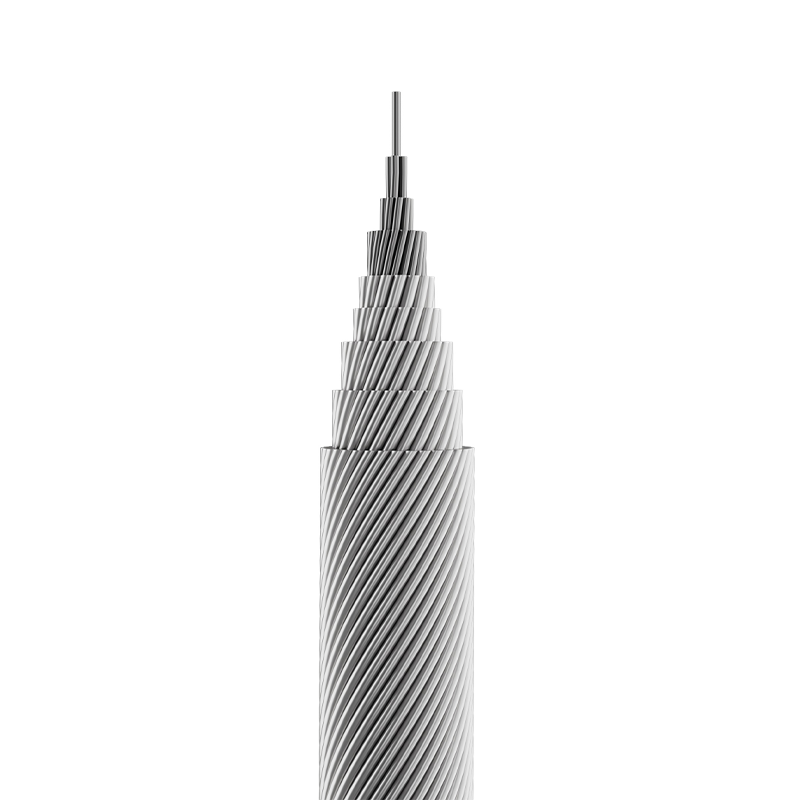
Bare conductor (AAC, AAAC, ACSR, ACAR)
Lowest cost per metre and the best cooling, since the whole surface is exposed to air. Continuous rating is typically 70–90 °C. It demands generous clearance and a wide right-of-way, and every branch is a potential fault path.
Covered conductor
XLPE or HDPE covered, 11–36 kV. Not fully insulated, so contact is still hazardous, but the cover slows surface tracking and cuts tree-related outages sharply in bushfire and plantation corridors.
Aerial bundled cable (ABC)
0.6/1 kV, three phases and neutral twisted together. Fits narrow streets, resists illegal tapping better than bare wire, and can be run on facades and short poles where a conventional line will not fit.
Insulated overhead cable, 10–35 kV
XLPE insulated with semiconductive screens, rated 90 °C continuous. The default for urban feeders and coastal corridors where salt fog destroys bare-line hardware and where clearance is tight.
HTLS conductor
ACSS or composite-core designs running at 150–200 °C. Ampacity gains of 50–100 percent on existing towers, bought at two to four times the conductor cost and a stricter hardware spec.
On a bare-conductor project the conductor is the product itself, so conductor grade decides everything downstream: AAAC for coastal and industrial atmospheres, ACSR with an aluminium-clad core where mechanical strength matters more than conductivity, and compacted or concentric-stranded constructions where ice loading or vibration history on the route has been unkind.
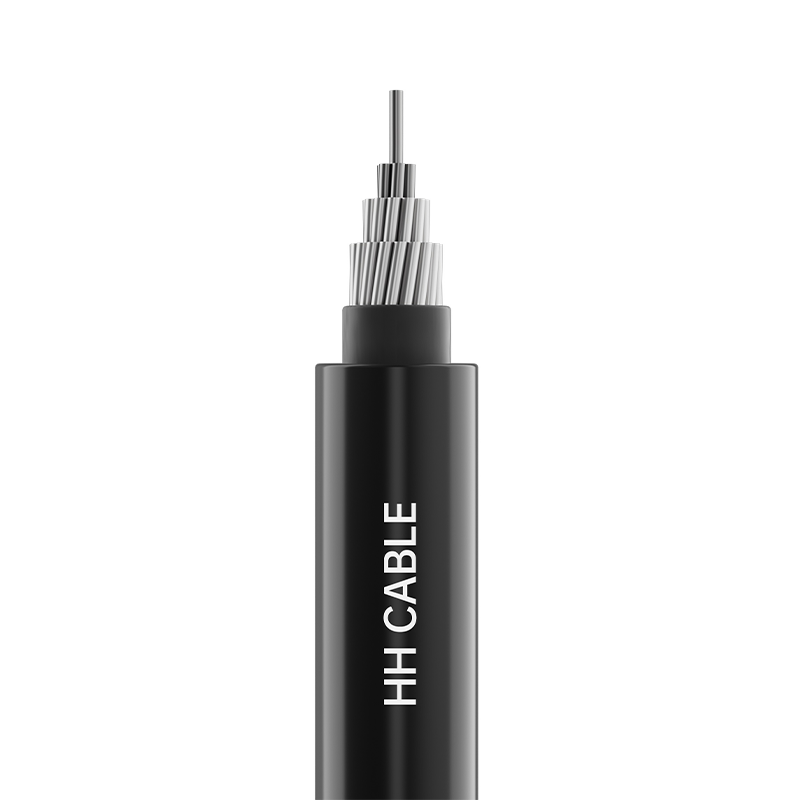 20 kV Steel-Core Reinforced Overhead Insulated CableFor rural grid upgrades and long-span crossings, this cable combines steel-core reinforcement with overhead insulation to improve strength and sag without changing tower loads.View Product →
Comparing Constructions on the Figures That Matter
The comparison below uses the parameters that decide whether a line survives its design life. Cost is an index against bare ACSR at 1.0, installed, including hardware but excluding right-of-way and pole changes.
A 10 kV insulated feeder at index 2.0 looks expensive next to bare conductor until the corridor is priced in: a narrower right-of-way, shorter poles and no annual tree crew. In a dense urban corridor that combination usually brings the insulated option below bare conductor on total installed cost, and it stays there through the maintenance budget.
 10 kV Overhead Insulated Cable for Distribution NetworksDesigned for urban and rural grid upgrades, this 10 kV cable replaces bare conductors to reduce shock risk and supports compact, safer overhead distribution.View Product →
Hidden Indicators the Quotation Never Shows
Two suppliers can pass the same type test and still deliver different service lives. The figures below are what field engineers track, and what a unit-price comparison cannot capture.
Bare ACSR
4.1
4.1
Covered
1.4
1.4
ABC
0.9
0.9
10 kV insulated
0.8
0.8
HTLS
0.6
0.6
Service interruptions per 100 km per year, indicative field averages. Most bare-line interruptions come from vegetation contact and insulator flashover, not from the conductor breaking. The covered and bundled options buy that reliability with material cost, which is why the index gap in the previous table is narrower than the outage gap here.
Conductor failure itself is slower and quieter: aeolian vibration fatigue at suspension clamps, crevice corrosion where moisture sits against the steel core, and thermal degradation behind a loose compression joint that was never re-torqued. None of these appear in a delivery inspection. All of them appear in year seven.
Where the Volume Actually Sits
Overhead cable demand is dominated by distribution, not transmission. That single fact explains most of the specification differences buyers encounter between utility and industrial projects.
- LV and MV distribution networks: 46 percent
- Transmission at 66 kV and above: 18 percent
- Industrial and rail feeding: 16 percent
- Renewable collection lines: 12 percent
- Rural electrification and other: 8 percent
The distribution share is why 1 kV aerial bundled cable and 10 kV insulated overhead cable carry so much volume, and why the LV side is often the most price-sensitive segment of the whole category. It is also where theft and illegal tapping change the buying decision more than any technical parameter.
 1 kV Overhead Insulated Cable for LV DistributionFor fixed overhead LV lines in urban and rural grids, this cable offers weather-resistant insulation and low transmission loss for long-distance distribution.View Product →
A Five-Step Specification and Buying Sequence
The sequence below is the one that keeps a project out of trouble at award stage. Skipping step one or step three is what turns a cheap line into an expensive one.
1. Fix the design inputs
System voltage, fault level, span, ice and wind loads, ambient temperature and the clearance code. Sag-tension calculations depend on all six, and changing one after award usually means new hardware.
2. Choose by dominant failure mode
Name the three most expensive risks on the route, whether trees, theft, salt fog or ice, and select the construction that removes the costliest one.
3. Verify test data, not catalogue claims
DC resistance at 20 °C to IEC 61089, insulation thickness and hot-set elongation for XLPE, water penetration for screened cable, tracking and erosion resistance for covered conductor.
4. Audit process capability
Online diameter and eccentricity monitoring on the insulation line, stranding and compaction control, and a routine-test record for every drum rather than a single type-test certificate.
5. Lock the interfaces
Drum lengths against span and pulling tension, tension-stringing limits, suspension and dead-end hardware, armour rods, vibration dampers, and sag-tension tables shipped with the cable.
Maintenance and Compliance That Keep the Line in Service
An overhead line is a structure that moves. Most compliance work is therefore about recording movement rather than checking paperwork.
- Re-measure sag and ground clearance after creep settlement, at year one and again around year ten, and after any fault that involved conductor movement.
- Run a thermographic patrol on joints, dead-ends and clamps each year on loaded feeders; a warm compression joint is the earliest available warning of a failure.
- Inspect vibration dampers and armour rods after high-wind events, particularly on long spans over open ground.
- Keep the tree-cutting cycle on schedule; on covered conductor it can be relaxed, but not cancelled.
- In coastal and industrial atmospheres, check conductor and hardware corrosion annually and confirm that the jointing compound still meets the relevant grease specification.
On the documentation side, keep type-test certificates, routine-test reports and drum-level traceability together, aligned with the standard the line was designed to. As a rule, the gap between infrastructure-grade and standard cable is a materials and testing question, and the audit trail is what proves which one was actually installed.
None of this makes overhead power cables hard to buy. It makes them easy to buy badly, because the cheapest per-metre option and the cheapest per-decade option are rarely the same product. Start from the failure mode, price the corridor rather than the drum, and the technical comparison becomes a shortlist instead of an argument.
PREV:No previous article
NEXT:Industrial Electrical Cable Guide: Ratings, Derating, and Selection Tips
NEXT:Industrial Electrical Cable Guide: Ratings, Derating, and Selection Tips
Interested in cooperation or have questions?
Featured Products
Comprehensive Cable Solutions


Ready To Customise
Your Cable Products?
Your Cable Products?

Customized Cable Solutions, Bulk Wire Supplier in China. Relying on genuine core quality to build a renowned brand, striving to become a benchmark for advanced
cable standards.
Product Categories
Quick Links
Contact Us
-
Email: [email protected]

-
Mobile: +86-0510-87296815

-
Fax: +86-0510-87295158

-
No. 1, Fengyi Jinfeng Road, Guanlin Town, Yixing City, Jiangsu Province, China

Copyright © Wuxi Henghui Cable Co., Ltd. All Rights Reserved. Custom Cable Manufacturers Electrical Cables Factory
