


 English
 中文简体
中文简体 русский
XLPE Insulated Control Cable 450/750V: Specs, Types & Installation Guide
XLPE Insulated Control Cable 450/750V: Specs, Types & Installation Guide
XLPE Insulated Control Cable 450/750V: Specs, Types & Installation Guide
XLPE Insulated Control Cable 450/750V: Specs, Types & Installation Guide
XLPE Insulated Control Cable 450/750V: Specs, Types & Installation Guide
XLPE Insulated Control Cable 450/750V: Specs, Types & Installation Guide
XLPE Insulated Control Cable 450/750V: Specs, Types & Installation Guide
XLPE Insulated Control Cable 450/750V: Specs, Types & Installation Guide
XLPE Insulated Control Cable 450/750V: Specs, Types & Installation Guide
XLPE Insulated Control Cable 450/750V: Specs, Types & Installation Guide
XLPE Insulated Control Cable 450/750V: Specs, Types & Installation Guide
XLPE Insulated Control Cable 450/750V: Specs, Types & Installation Guide
XLPE Insulated Control Cable 450/750V: Specs, Types & Installation Guide
XLPE Insulated Control Cable 450/750V: Specs, Types & Installation Guide
XLPE Insulated Control Cable 450/750V: Specs, Types & Installation Guide
XLPE Insulated Control Cable 450/750V: Specs, Types & Installation Guide

Industry News
Home / News / Industry News / XLPE Insulated Control Cable 450/750V: Specs, Types & Installation Guide
Product Category
NEW Category
Contact us
 +86-0510-87296815
XLPE Insulated Control Cable 450/750V: Specs, Types & Installation Guide
Control cables are not a commodity. A faulty signal line in a power distribution unit, a failed monitoring circuit in a petrochemical plant, or an undersized cable in a buried conduit system can stop operations, trigger safety shutdowns, or cause equipment damage that takes weeks to repair. As industrial automation expands and infrastructure projects grow more complex, the insulation material chosen for control cables is coming under greater scrutiny — and XLPE is consistently replacing PVC as the preferred specification for demanding applications.
The 450/750V XLPE insulated control cable is now one of the most widely specified cable types in industrial control, protection, and signal transmission systems. Understanding what drives that preference — and what the key parameters mean in practice — helps engineers, procurement teams, and contractors make better decisions at the specification stage rather than the troubleshooting stage.
Content
Why 450/750V XLPE Control Cables Are Gaining Ground in Industrial Projects
The shift from PVC to XLPE insulation in control cable applications is not driven by one factor alone. It reflects a combination of tighter operating conditions, longer expected service lives, and growing use of sensitive electronics in control circuits that cannot tolerate the voltage spikes and thermal stress that PVC-insulated systems may allow.
Industrial facilities — power stations, substations, petrochemical plants, mines, and large commercial buildings — all share a common requirement: control and protection circuits must operate reliably for years, often in environments where ambient temperatures are elevated, installation paths are complex, and maintenance access is limited. XLPE insulation addresses these conditions directly, offering a 90°C continuous conductor temperature rating compared to 70°C for standard PVC, better resistance to moisture and chemical exposure, and superior short-circuit tolerance.
For buyers and specifiers, the practical result is that 450-750V cross-linked polyethylene insulated control cables can carry higher current loads at lower risk of premature insulation degradation, reducing the total cost of ownership over a system's service life even when the upfront price is slightly higher than equivalent PVC-insulated types.
Key Technical Parameters Explained
The performance specifications for 450/750V XLPE control cables are defined by recognized standards including GB/T 9330, IEC, and AS/NZS 5000.3. Three parameters in particular define how the cable behaves under normal and fault conditions:
- Maximum conductor temperature during normal operation: 90°C. This is the continuous rated temperature of the conductor — the temperature the cable can sustain indefinitely without degrading its insulation. At 90°C, XLPE maintains its electrical and mechanical integrity. PVC begins to soften and lose insulation resistance at temperatures that XLPE handles without concern. In practical terms, a 90°C rating allows the cable to carry more current for a given conductor cross-section, or to operate safely in environments where ambient temperatures are elevated.
- Maximum conductor temperature during short circuit: 250°C (duration not exceeding 5 seconds). Short-circuit events produce sudden, intense heat. The 250°C limit defines the peak temperature the conductor can reach during a fault without causing permanent damage to the insulation that would compromise future performance. This rating is significantly higher than the 160°C typically permitted for PVC-insulated cables, giving XLPE control cables greater tolerance for fault conditions in protection circuits where such events are a design consideration.
- Minimum installation temperature: 0°C. Cables installed below 0°C risk cracking of the insulation or outer sheath due to reduced material flexibility in cold conditions. For applications in cold storage facilities, outdoor installations in cold climates, or winter construction projects, this limit must be observed — or a low-temperature-rated variant specified.
Cable Construction and Type Selection
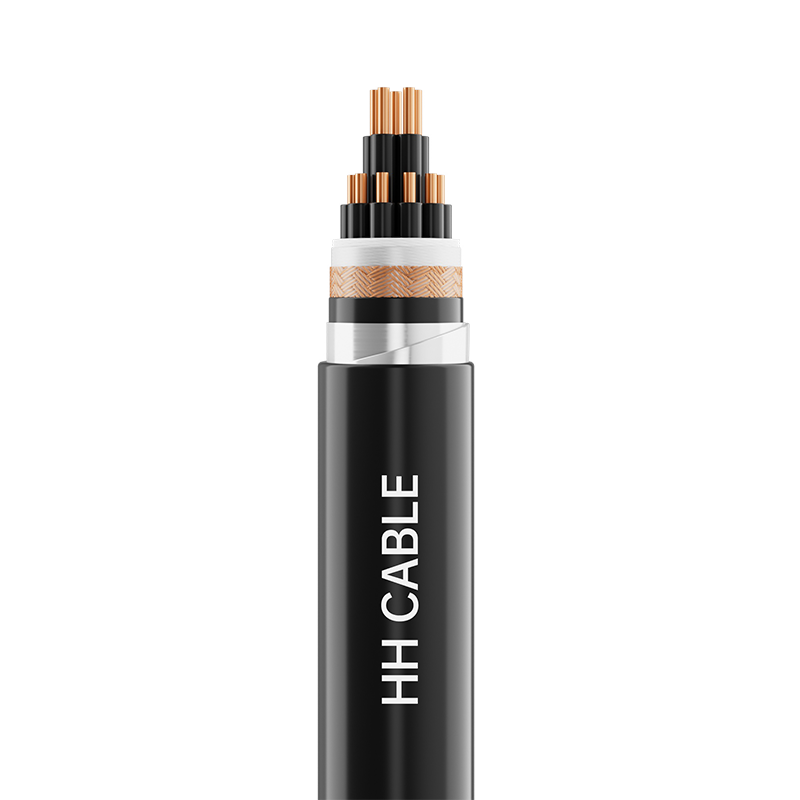
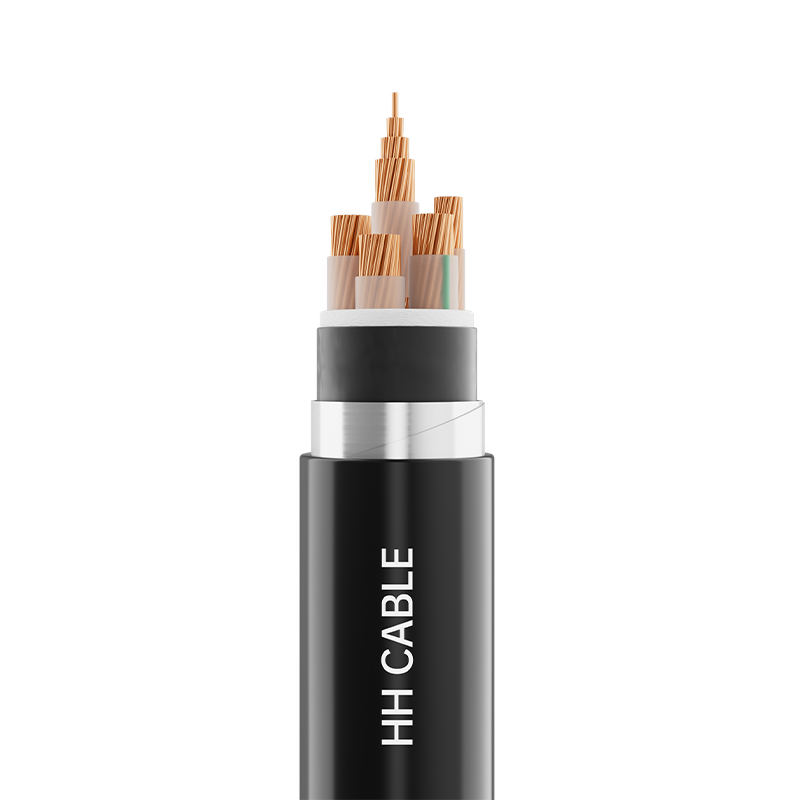
The 450/750V XLPE control cable family covers a range of constructions designed for different installation environments and shielding requirements. The core structure — copper conductor, XLPE insulation, optional screen, optional armour, PVC or LSZH outer sheath — remains consistent, but the combination of these layers determines which type is appropriate for a given application.
| Type | Construction | Typical Application |
|---|---|---|
| KYJV | CU/XLPE/PVC | General indoor and outdoor fixed installation; control and signal circuits |
| KYJVP | CU/XLPE/Copper braid screen/PVC | Circuits requiring EMI protection; sensitive signal and monitoring systems |
| KYJVP2 | CU/XLPE/Copper tape screen/PVC | Higher-frequency shielding requirements; instrumentation and protection circuits |
| KYJV22 | CU/XLPE/Steel tape armour/PVC | Direct burial; mechanical protection required; underground industrial installations |
| KYJV32 | CU/XLPE/Steel wire armour/PVC | Buried installations with higher tensile load requirements; vertical runs |
| KYJVR | CU/XLPE/PVC (flexible) | Applications requiring repeated flexing; mobile equipment connections |
Core counts range from 2 to 61 cores for smaller conductor cross-sections (0.5–1.0 mm²), narrowing to 2–10 cores for larger sizes (4–10 mm²). For most control and signal circuits, 1.5 mm² and 2.5 mm² conductors in multi-core configurations cover the majority of applications. The full range of industrial control and instrumentation cable solutions including screened and armoured variants is available for project-specific requirements.
Installation Requirements: Bending Radius and Laying Methods
Correct installation practices protect the cable's insulation and conductor integrity throughout its service life. Two requirements that are frequently overlooked — or applied inconsistently — are minimum bending radius and installation temperature. Both are defined by the cable standard and must be respected during cable pulling, tray installation, and conduit routing.
Minimum bending radius rules vary by cable construction:
- Flexible (soft structure) cables: bending radius not less than 6 times the overall cable outer diameter (6D). These apply to KYJVR and similar flexible-stranded variants used in dynamic or restricted-routing applications.
- Unarmoured cables: bending radius not less than 8 times the outer diameter (8D). This applies to standard fixed-installation types such as KYJV and KYJVP where no armour layer is present.
- Armoured and metal-shielded cables: bending radius not less than 12 times the outer diameter (12D). The steel tape or wire armour and copper screen layers reduce flexibility, requiring a larger minimum bend to avoid deforming or cracking these protective elements.
Exceeding the minimum bending radius — pulling a cable too tight around a corner or through a conduit bend — risks damaging the conductor stranding, cracking the insulation, or collapsing the screen, all of which compromise electrical performance and may not be immediately visible.
For laying methods, the 450/750V XLPE control cable is suitable for fixed indoor and outdoor installation, direct burial in cable pipes and cable trenches, and conduit systems. Where direct burial is specified, armoured types (KYJV22 or KYJV32) provide the necessary mechanical protection against soil pressure and incidental contact.
XLPE vs PVC: Why the Insulation Choice Matters for Control Circuits
Both XLPE and PVC are widely used as insulation materials in 450/750V control cables, and both meet the rated voltage requirement. The difference lies in how they perform over time and under stress.
| Property | XLPE Insulation | PVC Insulation |
|---|---|---|
| Max continuous conductor temperature | 90°C | 70°C |
| Max short-circuit temperature | 250°C (≤5 seconds) | 160°C (≤5 seconds) |
| Moisture resistance | Excellent | Good |
| Chemical resistance | High | Moderate |
| Long-term insulation stability | High (thermoset, does not re-melt) | Moderate (thermoplastic, softens at elevated temp) |
| Suitable for direct burial | Yes (with armour) | Yes (with armour) |
| Typical service life | 25–30 years | 15–20 years |
For control circuits in power stations, industrial automation systems, and protection networks, where insulation degradation can cause nuisance trips, false signals, or actual failures, the higher thermal rating and long-term stability of XLPE represent a meaningful operational advantage. PVC remains appropriate for lower-stress installations where cost is the primary constraint and operating conditions are controlled. Where the environment involves elevated temperatures, chemical exposure, direct burial, or long service life requirements, XLPE is the more defensible specification choice.
Wuxi Henghui Cable manufactures 450-750V XLPE insulated control cables across the full range of construction types — from standard KYJV to screened and armoured variants — under ISO-certified quality management. Custom specifications including LSZH sheathing, low-temperature ratings, and flame-retardant classifications are available for project-specific requirements.
PREV:Control Cables: Selection, Shielding & Installation Guide
NEXT:10kV Overhead Insulated Cable Tree Guide
NEXT:10kV Overhead Insulated Cable Tree Guide
Interested in cooperation or have questions?
Featured Products
Comprehensive Cable Solutions


Ready To Customise
Your Cable Products?
Your Cable Products?

Customized Cable Solutions, Bulk Wire Supplier in China. Relying on genuine core quality to build a renowned brand, striving to become a benchmark for advanced
cable standards.
Product Categories
Quick Links
Contact Us
-
Email: [email protected]

-
Mobile: +86-0510-87296815

-
Fax: +86-0510-87295158

-
No. 1, Fengyi Jinfeng Road, Guanlin Town, Yixing City, Jiangsu Province, China

Copyright © Wuxi Henghui Cable Co., Ltd. All Rights Reserved. Custom Cable Manufacturers Electrical Cables Factory
