


 English
 中文简体
 русский
What Is MI Cable? Mineral Insulated Cable Construction, Ratings and Selection
What Is MI Cable? Mineral Insulated Cable Construction, Ratings and Selection
What Is MI Cable? Mineral Insulated Cable Construction, Ratings and Selection
What Is MI Cable? Mineral Insulated Cable Construction, Ratings and Selection
What Is MI Cable? Mineral Insulated Cable Construction, Ratings and Selection
What Is MI Cable? Mineral Insulated Cable Construction, Ratings and Selection
What Is MI Cable? Mineral Insulated Cable Construction, Ratings and Selection
What Is MI Cable? Mineral Insulated Cable Construction, Ratings and Selection
What Is MI Cable? Mineral Insulated Cable Construction, Ratings and Selection
What Is MI Cable? Mineral Insulated Cable Construction, Ratings and Selection
What Is MI Cable? Mineral Insulated Cable Construction, Ratings and Selection
What Is MI Cable? Mineral Insulated Cable Construction, Ratings and Selection
What Is MI Cable? Mineral Insulated Cable Construction, Ratings and Selection
What Is MI Cable? Mineral Insulated Cable Construction, Ratings and Selection
What Is MI Cable? Mineral Insulated Cable Construction, Ratings and Selection
What Is MI Cable? Mineral Insulated Cable Construction, Ratings and Selection

Industry News
Home / News / Industry News / What Is MI Cable? Mineral Insulated Cable Construction, Ratings and Selection
Product Category
NEW Category
Contact us
 +86-0510-87296815
What Is MI Cable? Mineral Insulated Cable Construction, Ratings and Selection
A fire alarm riser is usually the last cable anyone argues about — until the specification review asks for a circuit that keeps working at 950°C for three hours while the floor around it is being doused with water. At that point the discussion stops being about copper cross-section and becomes a question about what sits between the conductor and the flame.
The short answer: MI cable (mineral insulated cable) is a copper conductor packed in magnesium oxide powder and sealed inside a seamless copper sheath. There is no polymer anywhere in the construction, so there is nothing to burn, nothing to melt into smoke, and nothing to feed a fire.
Standard grades run continuously at around 250°C, survive 950°C fire tests with water spray and mechanical shock, and still hold their insulation resistance afterwards. That one property — an entirely inorganic dielectric — explains the price, the installation quirks, and why the product keeps a narrow but irreplaceable slot in fire engineering.
The trade-off is equally clear. MI cable is stiff, it needs specialist terminations at every end, and it costs several times more per metre than an armoured polymer cable. Knowing where that premium actually buys you something is the whole decision.
Content
How MI Cable Is Built: Three Materials, One Continuous Process
The construction is simple enough to describe in one sentence, which is precisely why it is difficult to manufacture well.
- Conductor: annealed copper, solid (class 1) or stranded (class 2), commonly 1 to 19 cores in the 0.5 mm² to 16 mm² range for building services, with larger power cores available.
- Insulation: magnesium oxide powder, compacted under the drawing dies until it behaves more like a ceramic than a loose powder.
- Sheath: a seamless copper tube formed around the core assembly. Cupronickel and stainless steel variants exist for aggressive, marine or very high-temperature routes.
- Optional oversheath: a low-smoke zero-halogen layer added purely for corrosion protection on buried or chemically exposed runs — it contributes nothing to fire performance.
Because the whole assembly is drawn down to its final diameter, the magnesium oxide is densified in place. There is no organic dielectric to carbonise and no continuous void for a flame to track along. The sheath is also seamless, so moisture has only one way in: the termination.
What that construction gives you in practice
Fire survival
The inorganic core keeps conducting under fire, water spray and impact conditions defined by recognised circuit-integrity tests.
Temperature headroom
Around 250°C continuous, far above any polymer insulation, which matters near ovens, steam lines and furnace areas.
Small diameter
A 4-core 2.5 mm² MI cable is often close to half the diameter of an armoured fire-rated equivalent, which matters in heritage and retrofit work.
Built-in earth
The copper sheath doubles as a circuit protective conductor, removing a separate core from the design.
Mechanical toughness
The metal sheath resists crushing and rodent attack without additional armouring.
Zero halogen
No chlorine, no fluorine, no toxic effluent and effectively no smoke contribution from the cable itself.
MI Cable Compared With the Alternatives
Specifiers rarely choose MI cable in isolation. The realistic comparison is against armoured XLPE and against specialist fire-rated polymer cables, and the differences are not only electrical.
Indicative figures for a 4-core 2.5 mm² 450/750 V circuit; treat them as planning values, not catalogue data.
The Numbers That Actually Decide the Specification
Two figures carry more weight than any marketing claim: the continuous temperature rating, and what the cable is still doing after the fire test ends.
Continuous conductor temperature rating (°C)
MI 250
Silicone 180
XLPE 90
PVC 70
- Circuit-integrity testing is usually quoted as a three-part regime: fire alone, fire with water spray, and fire with mechanical shock. A product that passes only the first category is a very different purchase from one that passes all three.
- Insulation resistance is measured at 500 V DC. A dry, correctly terminated new run typically reads in the gigaohm range; anything below roughly 100 MΩ almost always points to moisture that has entered through a gland rather than a fault in the cable.
- The hidden cost driver is termination labour. A skilled technician needs tens of minutes per end on an MI pot; multiply that by every gland in a riser and the accessory labour can approach the cable cost itself.
Where MI Cable Is Actually Used
The product sits in life-safety and extreme-environment work rather than general distribution. The split below reflects typical specification patterns in commercial and industrial projects.
Fire detection and alarm circuits — 32%
Emergency lighting and life safety — 22%
High-temperature industrial plant — 18%
Petrochemical and hazardous areas — 14%
Tunnels and transport infrastructure — 9%
Heritage, marine and other retrofits — 5%
The pattern makes sense once you look at what each sector is buying. A petrochemical operator wants a cable that will not release a flammable volatile from its own insulation; a heritage building wants fire performance in a diameter that will fit an existing conduit; a tunnel operator wants both plus a sheath that survives washing down.
A Practical Selection Path
- Start from the fire strategy, not the cable. If a circuit must keep functioning for 30, 60 or 120 minutes, you need a tested system — cable, glands and supports together. Cable alone is only part of the tested assembly.
- Confirm voltage grade and core count. 300/500 V covers alarm and control circuits; 450/750 V covers power to fire pumps, pressurisation fans and smoke extract equipment.
- Match the sheath to the environment. Plain copper indoors, cupronickel or an oversheathed version for buried, damp or chemically aggressive routes.
- Plan terminations before the drums arrive. Confirm the accessory kit, the crimp tool and a competent installer. This is where MI projects fail, not in the cable.
- Price the installed system per circuit. Comparing cable cost per metre flatters the polymer alternative; comparing cost per completed, tested circuit gives the honest answer.
Around the fire-rated circuits, most of the building still runs on conventional insulation. Distribution boards, sub-mains and motor feeders where circuit integrity is not mandated are normally served by crosslinked polyethylene constructions, which is where the mainstream of a project budget sits.
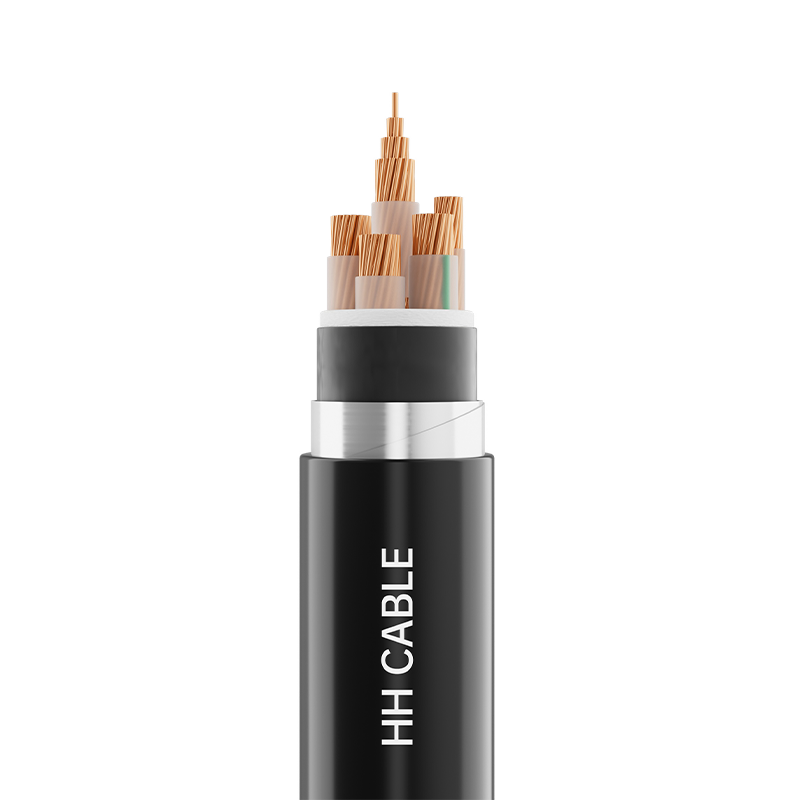 XLPE Insulated Power Cables up to 1.8/3kVFor distribution boards, sub-mains and motor feeders without mandated circuit integrity, these XLPE power cables cover 0.6/1kV and 1.8/3kV fixed installations.View Product →
Control and instrumentation loops follow the same logic: shielded XLPE or PVC control cables handle switching and signalling, while MI is reserved for the handful of circuits with a defined survival requirement.
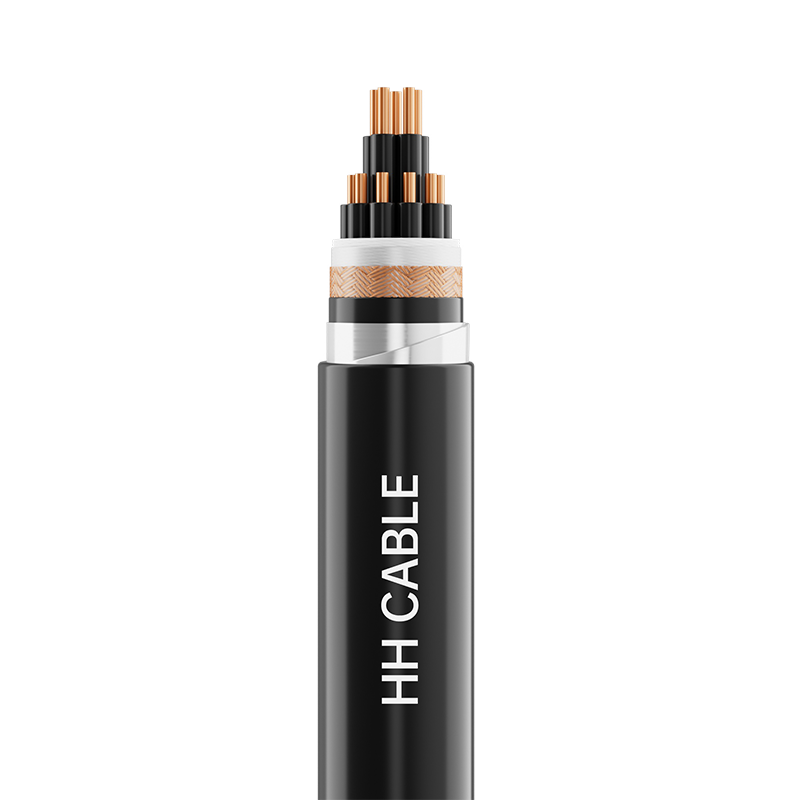 450/750V XLPE Control Cables for Instrumentation CircuitsFor control and instrumentation loops, these 450/750V XLPE-insulated cables support switching, signalling, monitoring and protection circuits in fixed indoor, outdoor or buried installations.View Product →
Maintenance, Testing and Compliance Notes
An MI installation is maintenance-light but not maintenance-free, and almost all of its service life is decided on the day it is terminated.
- Record insulation resistance at commissioning and after every intervention. A downward drift between readings is the earliest sign of a compromised seal.
- Inspect glands annually in plant rooms and wash-down areas. Magnesium oxide is hygroscopic — once moisture reaches it, resistance collapses and the run must be re-terminated.
- Respect the bend radius on the data sheet. For annealed copper sheaths this is typically a few multiples of the outer diameter, and larger sizes need annealing before forming.
- On the compliance side, look for type-test certificates covering the actual fire category claimed, not a generic material statement. The relevant documents usually sit around the cable and termination standards, plus regional wiring regulations.
- Keep the drawing package current. Because MI cable is rigid and joints are permanent, later cable additions are far harder than on a tray-fed polymer system.
The most common failure is not a cable defect at all — it is a fire-rated circuit installed with the same care as an ordinary one, which is why workmanship on fire-critical wiring deserves as much attention in the specification as the product datasheet.
MI cable is best understood as a narrow, expensive answer to a specific question: how do you keep a circuit alive when everything organic around it has already failed? If your project only needs a conductor that carries current reliably at normal temperatures, an XLPE cable will do the job at a fraction of the cost and far less installation friction. If the circuit is written into a fire strategy with a defined survival time, the inorganic construction stops being a premium and starts being the only thing that satisfies the requirement.
The practical rule from the manufacturing side is straightforward: decide the fire performance first, then size, then terminations, and only then look at price per metre. Reversing that order is how projects end up with either an over-specified budget or a life-safety circuit that cannot pass its commissioning test.
PREV:Power Line Cables: Selection by Voltage, Route, Insulation, and Test Regime
NEXT:Shielded vs Unshielded Cable: A Practical Selection Guide for Industrial Buyers
NEXT:Shielded vs Unshielded Cable: A Practical Selection Guide for Industrial Buyers
Interested in cooperation or have questions?
Featured Products
Comprehensive Cable Solutions


Ready To Customise
Your Cable Products?
Your Cable Products?

Customized Cable Solutions, Bulk Wire Supplier in China. Relying on genuine core quality to build a renowned brand, striving to become a benchmark for advanced
cable standards.
Product Categories
Quick Links
Contact Us
-
Email: [email protected]

-
Mobile: +86-0510-87296815

-
Fax: +86-0510-87295158

-
No. 1, Fengyi Jinfeng Road, Guanlin Town, Yixing City, Jiangsu Province, China

Copyright © Wuxi Henghui Cable Co., Ltd. All Rights Reserved. Custom Cable Manufacturers Electrical Cables Factory
