


 English
 中文简体
中文简体 русский
Railway Cable for Tram Power Systems Guide
Railway Cable for Tram Power Systems Guide
Railway Cable for Tram Power Systems Guide
Railway Cable for Tram Power Systems Guide
Railway Cable for Tram Power Systems Guide
Railway Cable for Tram Power Systems Guide
Railway Cable for Tram Power Systems Guide
Railway Cable for Tram Power Systems Guide
Railway Cable for Tram Power Systems Guide
Railway Cable for Tram Power Systems Guide
Railway Cable for Tram Power Systems Guide
Railway Cable for Tram Power Systems Guide
Railway Cable for Tram Power Systems Guide
Railway Cable for Tram Power Systems Guide
Railway Cable for Tram Power Systems Guide
Railway Cable for Tram Power Systems Guide

Industry News
Product Category
NEW Category
Contact us
 +86-0510-87296815
Railway Cable for Tram Power Systems Guide
Content
- 1 The Role of Railway Cable in Modern Tram Power Systems
- 2 Thermal Performance: Rated Temperatures Under Normal and Fault Conditions
- 3 Installation Requirements: Temperature and Bending Radius Limits
- 4 Rolling Stock Cable: On-Vehicle Wiring in Tram Applications
- 5 Functional Roles Across the Tram Power and Control System
- 6 Key Technical Properties That Determine Cable Suitability
- 7 Specifying and Procuring Railway Cable for Tram Projects
The Role of Railway Cable in Modern Tram Power Systems
Railway cable serves as the circulatory backbone of urban rail transit infrastructure. In tram power supply system projects specifically, it functions as the core component connecting the power supply network with live tram operations — a role that demands far more than basic electrical conductivity. The cable must simultaneously manage power transmission, signal integrity, safety functions, and environmental resilience across decades of continuous service.
Unlike general industrial cabling, railway cable is designed to withstand the unique combination of mechanical stress, electromagnetic interference, thermal cycling, and exposure conditions found in rail environments. Every meter of cable installed in a tram system runs through the entire process of power delivery — from substation output to on-vehicle distribution — making specification accuracy and installation quality critical to overall system reliability. Substandard cable at any point in this chain introduces risk into an environment where failure consequences extend beyond equipment damage to passenger safety.
Thermal Performance: Rated Temperatures Under Normal and Fault Conditions
Thermal management is one of the most technically demanding aspects of railway cable design. Two operating conditions define the thermal envelope that a compliant cable must handle without degradation:
Normal Operation — 90°C Conductor Temperature
The maximum long-term rated temperature allowed for the cable conductor during normal operation is 90°C. This figure governs the continuous current-carrying capacity of the cable and determines the insulation material class required. At 90°C, the insulation system — typically cross-linked polyethylene (XLPE) or specialized elastomeric compounds — must maintain full dielectric integrity, mechanical flexibility, and resistance to thermal aging without measurable deterioration over the cable's service life. Exceeding this temperature in sustained operation accelerates polymer chain degradation, progressively reducing insulation resistance and shortening service life.
Short Circuit Conditions — 250°C Peak Conductor Temperature
During short circuit events with a duration not exceeding 5 seconds, the maximum allowable temperature of the cable conductor rises to 250°C. This short-duration tolerance is a critical safety parameter — it defines the minimum conductor cross-section needed to survive a fault current without the conductor melting, insulation igniting, or mechanical failure occurring before protection devices can isolate the fault. The 5-second window corresponds to the maximum clearing time of protection systems in typical tram power supply configurations. Correct conductor sizing per this parameter ensures the cable acts as a passive safety element rather than a fault propagation point.
Installation Requirements: Temperature and Bending Radius Limits
Correct installation practice is as important as correct specification. Railway cable subjected to improper handling during installation can sustain invisible internal damage — micro-cracks in insulation, conductor kinking, or sheath deformation — that does not cause immediate failure but dramatically reduces service life and increases the probability of in-service faults. Two installation parameters are non-negotiable:
- Minimum installation temperature — 0°C: The cable installation temperature should not be lower than 0°C. Below this threshold, the insulation and sheath materials stiffen and lose the flexibility required for safe handling. Attempting to uncoil, route, or bend railway cable in sub-zero conditions risks brittle fracture of the outer sheath and insulation layers, even when no visible cracking is apparent. In cold-climate tram projects, cable reels must be stored in heated environments and brought to above-freezing temperature before installation commences.
- Minimum bending radius — 20 times outer diameter: The minimum bending radius for cable installation must not be less than 20 times the outer diameter of the cable. For a cable with a 30 mm outer diameter, this translates to a minimum bend radius of 600 mm. This requirement prevents conductor strand separation, insulation compression on the inner bend radius, and sheath overstress at routing transitions. In practice, all conduit bends, cable tray corners, and transition points must be pre-planned to accommodate this radius — site modifications after laying are rarely feasible without cutting and re-terminating.
These two parameters should be explicitly included in installation method statements and inspected at hold points during construction. Post-installation testing alone cannot detect bending radius violations that occurred during cable pulling.
Rolling Stock Cable: On-Vehicle Wiring in Tram Applications
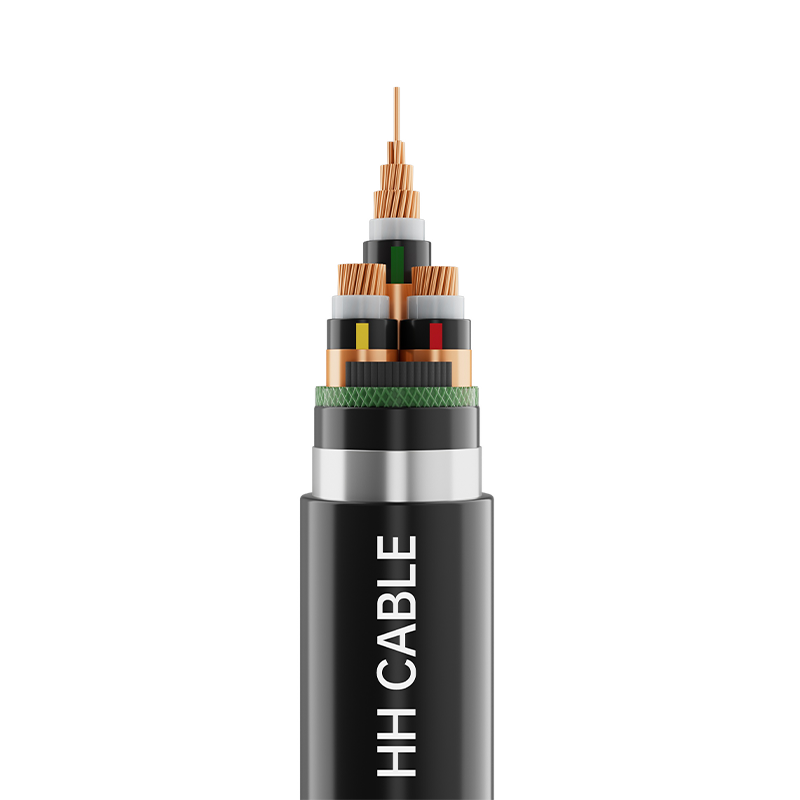
Rolling stock cable refers specifically to the cabling installed within rail vehicles — trams, metro cars, and locomotives — rather than trackside infrastructure. This distinction matters because the operating environment inside a rail vehicle introduces a distinct set of stresses not present in fixed installations.
On-board rolling stock cable must contend with continuous vibration from traction motors and track irregularities, frequent flexing at articulation points between tram sections, oil and fluid contamination in underframe areas, and the electromagnetic interference generated by traction inverters and power electronics operating at high switching frequencies. The cable construction — conductor stranding class, insulation compound, screening configuration, and sheath formulation — must be selected specifically for these combined stresses rather than adapted from static installation cable.
For tram applications, rolling stock cable typically uses finely stranded copper conductors (Class 5 or Class 6 per IEC 60228) to provide flexibility under repeated movement, halogen-free flame-retardant (HFFR) insulation to limit toxic gas emission in the event of fire in an occupied vehicle, and braided or foil shielding on signal circuits to suppress interference from the traction system operating in close proximity.
Functional Roles Across the Tram Power and Control System
Railway cable and rolling stock cable together cover every functional layer of the tram system. The following table outlines the primary cable functions, their circuit types, and the performance characteristics most critical to each:
| Function | Circuit Type | Key Performance Requirement |
|---|---|---|
| Traction power transmission | High-voltage DC/AC feeder | High conductivity, 90°C rated, short-circuit withstand to 250°C |
| Signal and control | Low-voltage data and control | Anti-interference shielding, signal integrity under EMI |
| Safety and protection | Emergency circuits, earth bonding | Fault current withstand, fire performance, circuit continuity |
| Auxiliary power distribution | On-vehicle AC/DC distribution | Flexibility, heat resistance, HFFR sheath compound |
Each functional layer demands a different cable construction. Using a single cable type across all circuits is a false economy — compromising either the power circuit's current capacity or the signal circuit's interference immunity. Correct cable scheduling, matched to circuit function, is foundational to stable system operation.
Key Technical Properties That Determine Cable Suitability
Four core technical properties determine whether a railway cable or rolling stock cable is fit for tram power supply service. Each addresses a specific operational challenge inherent to the rail environment:
- High conductivity: Low conductor resistance minimizes power losses across long cable runs between substations and tram stops. In DC tram systems, resistive voltage drop is a direct operational constraint — excessive drop reduces available traction voltage at the vehicle and limits performance during acceleration. High-conductivity copper or appropriately sized aluminum conductors, selected per verified ampacity calculations, are essential to efficient power delivery.
- Heat resistance: With a maximum long-term conductor temperature of 90°C and short-circuit withstand to 250°C, the insulation system must be thermally stable across both operating regimes. XLPE insulation achieves this through cross-linked polymer chains that resist thermal deformation without the need for continuous cooling. Heat resistance also prevents insulation softening in enclosed cable ducts during summer operation where ambient temperatures inside conduits can exceed 50°C.
- Anti-interference ability: Tram power systems generate significant electromagnetic interference from pantograph arcing, traction inverter switching, and regenerative braking transients. Signal and control cables running in parallel with power feeders must incorporate effective shielding — typically aluminum-foil tape with drain wire, or copper braid — to maintain signal integrity and prevent spurious triggering of safety-critical control functions.
- Environmental adaptability: Trackside railway cable faces UV exposure, moisture ingress, mechanical impact from trackside machinery, and chemical contamination from rail lubricants and de-icing compounds. On-vehicle rolling stock cable contends with oil, vibration, and thermal cycling. The outer sheath compound — whether PVC, polyurethane, or HFFR — must be selected to resist the specific chemical and mechanical environment at each installation point.
Specifying and Procuring Railway Cable for Tram Projects
Effective cable specification for tram power supply projects requires a systematic approach that ties cable parameters directly to circuit requirements. Generic specifications that define only voltage rating and conductor cross-section are insufficient — they leave critical performance gaps in thermal withstand, flexibility class, shielding effectiveness, and fire performance that only become apparent after installation or during commissioning.
A complete railway cable specification for tram applications should define the rated conductor temperature (90°C continuous), the short-circuit withstand temperature (250°C for up to 5 seconds), the applicable installation temperature floor (no installation below 0°C), the minimum bending radius (20 times outer diameter), the conductor class for the required flexibility, insulation and sheath material with fire performance classification, and screening requirements for each circuit type. Referencing applicable standards — EN 50264 for rolling stock cable, EN 50306 for railway signaling cable, or project-specific authority requirements — provides a compliance framework for supplier qualification and factory acceptance testing.
Railway cable and rolling stock cable that meet these combined requirements form the "blood vessel" of the tram system — quietly delivering power, signals, and protection commands throughout every operating hour. Investing in correct specification at the project outset is the most cost-effective way to ensure that this infrastructure performs reliably across the full design life of the urban rail transit network it supports.
PREV:Aluminum Alloy Core Overhead Insulated Cable Guide
NEXT:Solar Cable Size for Beginners: AWG Guide & Sizing Chart
NEXT:Solar Cable Size for Beginners: AWG Guide & Sizing Chart
Interested in cooperation or have questions?
Featured Products
Comprehensive Cable Solutions




Ready To Customise
Your Cable Products?
Your Cable Products?

Customized Cable Solutions, Bulk Wire Supplier in China. Relying on genuine core quality to build a renowned brand, striving to become a benchmark for advanced
cable standards.
Product Categories
Quick Links
Contact Us
-
Email: [email protected]

-
Mobile: +86-0510-87296815

-
Fax: +86-0510-87295158

-
No. 1, Fengyi Jinfeng Road, Guanlin Town, Yixing City, Jiangsu Province, China

Copyright © Wuxi Henghui Cable Co., Ltd. All Rights Reserved. Custom Cable Manufacturers Electrical Cables Factory
